Ebook Free The Dead Will Arise: Nongqawuse and the Great Xhosa Cattle-Killing Movement of 1856-7
Find the The Dead Will Arise: Nongqawuse And The Great Xhosa Cattle-Killing Movement Of 1856-7 in this website based upon the link that we have given. Of course, it will remain in soft file, however this way could alleviate you to acquire and use this publication. This intriguing publication is currently worried to the type of simple book creating with attractive topic to read. Besides, how they make the cover is really clever. It excels idea to see exactly how this publication attracts the viewers. It will also see how the visitors will choose this book to go along with while spare time. Allow's inspect and also be one of the people who get this book.
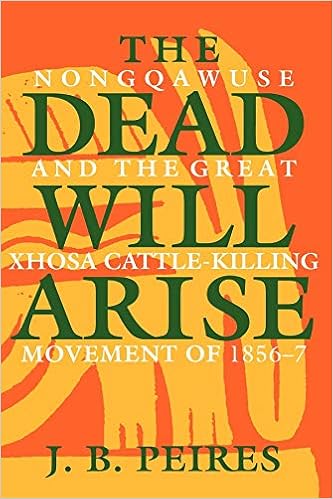
The Dead Will Arise: Nongqawuse and the Great Xhosa Cattle-Killing Movement of 1856-7

Ebook Free The Dead Will Arise: Nongqawuse and the Great Xhosa Cattle-Killing Movement of 1856-7
Searching particular publication in guides save could not promise you to get guide. Have you ever dealt with that trouble? This is a typical trouble that many people deal with while getting or get such particular publication. Customarily, a number of them will run out of the book provided and stocks in guide stress and anxiety furthermore, when it associates with the new launched book, the most effective vendor books, or the most popular books, it will certainly allow you await even more times to get it, unless you have handle it promptly.
With this condition, when you require a book hurriedly, never ever be worried. Just discover and see this site as well as get guide promptly. Now, when the The Dead Will Arise: Nongqawuse And The Great Xhosa Cattle-Killing Movement Of 1856-7 is what you seek for now, you can get this publication directly in this web page. By going to the web link that we provide, you can start to get this book. It is really basic, you might not should go offline and also see the collection or publication shops.
From the book, you will realize that reading is absolutely needed to do. It will direct you to get more valuable spending time. By reading the books, your hung around will not lose incorrectly. You can find just what you want and needs to observe. Below, the The Dead Will Arise: Nongqawuse And The Great Xhosa Cattle-Killing Movement Of 1856-7 comes to be a choice to check out the book due to the fact that it provides you the amazing attributes of the life. Even it is only the agent are for getting this type of book, you may see just how you can appreciate the book precisely.
This is just what you need to carry out in needing just what we provide. This is not nonsense, this is something to develop much better principle. Essentially, publication will not constantly influent somebody to act and also assume far better. It will certainly rely on just how the people will certainly gaze as well as consider the lesson given by the book. Yet, when you have managed reading guide arranged, the The Dead Will Arise: Nongqawuse And The Great Xhosa Cattle-Killing Movement Of 1856-7 will certainly have despite to call for.
Anyone who thinks that South Africa's problems began with the Afrikaners and apartheid should read this book." ―Richard Dowden, The Independent... should remain the last word for the foreseeable future." ―ChoicePeires is the premier historian of the Xhosa people. He speaks the language, knows the terrain, has collected oral traditions and has made an exhaustive study of the documented sources. The result is a fascinating and authoritative account of this astonishing catastrophe... The Dead Will Arise is fine scholarship and a good read. " ―The Washington Post, Book World [Peires] has done a splendid job, combining a narrative of epic tragic sweep with a deep grasp of the Xhosa language and society... this is a powerfully wrought work, one of the best in recent years on a precolonial South African people... " ―African Studies Review... The Dead Will Arise is remarkable for its clarity and accessibility.... It is bold, imaginative challenge to an orthodoxy which has persisted for one hundred and thirty years. The sophistication and scope of its analysis and its breath-taking literary style qualify The Dead Will Arise for the accolade ‘brilliant.’ " ―International Journal of African Historical Studies... gripping reading. It is now one hundred and thirty years since the tragic events of the Xhosa Cattle-Killing and yet this book is the very first thoroughly researched and authoritative account ever to be written on the subject." ―Journal of Religion in AfricaOne of the great strengths of this study is the rich biographical material that Peires provides on the various personalities involved in the incident." ―American Historical ReviewDrawing on private letters, spy reports, oral traditions, and obscure Xhosa texts, Peires explains for the first time the motivations which drove 100,000 Xhosa to kill their cattle, destroy their crops, and slowly starve to death―an extraordinary event that has defied historical explanati
Your recently viewed items and featured recommendations
›
View or edit your browsing history
After viewing product detail pages, look here to find an easy way to navigate back to pages you are interested in.
Product details
Paperback: 376 pages
Publisher: Indiana University Press - Indiana University Press; 1st Edition edition (September 22, 1989)
Language: English
ISBN-10: 9780253205247
ISBN-13: 978-0253205247
ASIN: 0253205247
Product Dimensions:
6 x 0.8 x 9 inches
Shipping Weight: 1.2 pounds (View shipping rates and policies)
Average Customer Review:
3.9 out of 5 stars
5 customer reviews
Amazon Best Sellers Rank:
#1,085,546 in Books (See Top 100 in Books)
The author J.B Peires was a Senior Lecturer in History at Rhodes University. He possessed a knack for turning historical data into emotionally stirring and controversial reading. This book proved to be a challenging read, taking me several years to research. There are indeed omissions, inconsistencies, conflicting versions and biased narratives.The year of 1856 was a disparaging time for the amaXhosa (Bantu) nation migrations occupying the Wild Coast, just as it were for other Nguni as well as the Khoikhoi / Khoisan indigenous peoples. Xhosa land was now under siege by British invaders - scattering them under a process known as "mfecane" - eventually weakening Bantu societies - unable to resist colonial expansion resulting in continuous loss of their territories and autonomy - the birth of apartheid governance and systematic order of white rule. In 1853, a lung disease began killing off the Xhosa’s cattle herds. By 1856-1857, South Africa (as many places within the world) suffered droughts which withered food harvests, and in the case of the Xhosa, their prized cattle were dwindling because of this *strange* infectious disease further exacerbated by drought conditions.AmaXhosa ambition seemed promising from the voice of a young girl called Nongqawuse, the niece of a prophet. Nongqawuse claimed ancestor spirits had prophetically counseled her during a visit in the Gxara River of an ancestral resurrection: "If the people would only kill all their cattle and burn their crops, a day would come when new cattle and crops would arise along with an army of the ancestors who would drive the whites into the sea."The 16-17 year old Nongqawuse's supposed *vision* absorbed the precarious condition of her people, and split the Xhosa into two groups; believers of the prophesy and non-believers; while believers followed her oracles, slaughtering their cattle and burning their remaining summer crops. The alleged *dedicated day* arrived and nothing happened. Starvation and disease occurred within months - greater than a third of the amaXhosa nation died. In turn, the British easily claimed the remnants of the defeated Xhosa kingdom and imprisoned their chiefs. Nongqawuse was arrested near the Mbashe River and imprisoned on Robben Island - held under a different name for her own safety - she was the target of Xhosa death threats, but her people were broken and tattered as a result of the cattle-killing. By the 1870s, white settlers occupied most of the Xhosa’s lands. The surviving Xhosa were rounded up and moved to reserves in British Kaffraria. Nongqawuse eventually released and returned to the Eastern Cape. Intriguingly enough, the name "Nongqawuse" by implication means "a spiritual experience."---------------------------------In 2012, I visited Johannesburg, South Africa for a six-month period. During this time, I learned about the "Xhosa Great Cattle-Killing" from a fairly prominent and accomplished South African (British) artist who captured a unique rendition of an ancestor speaking to Nongqawuse in his painting titled "The Message." The reality of his explanation, and ethnic "communication-centered" Drakensburg interpretation captivated my senses. I eagerly began to query many individuals over several months - to my dismay, I could only find one (black or colored) person with knowledge about Nongqawuse and the Xhosa cattle killing - or rather, who would admit to it. This person was a Xhosa man in his early thirties or so. He presented an imperviously lack-luster and sketchy account. Other Nguni persons; certain Sotho, Tswana, Tsonga-Shangaan, Ndebele, Zulu or Themba which I encountered daily displayed an innocuous ignorance or disinterest! A few individuals immediately passed it off as "just another white-lie." This provoked me (even more) to investigate via Internet and attempt to seek more information. My searching proved arduous and inconclusive in South Africa. Even respected friends and associates were not helpful, and (publically accessible) data about this subject seemed obscure and non-existent there, as if intentional. By the time I finally returned home, I was compelled and easily located various sources of information over the Internet and several written accounts.Throughout the 1850s and beyond, it is indeed a fact that Sir George Grey and the Cape Colonists experienced strained relations with the indigenous people of South Africa.(1). According to British interviews with Nongqawuse, the "risen ancestors" promised her that, if their requests be followed, more Xhosa ancestors would appear to provide food and 'drive the English out' of the country. The history of the cattle-killing has been explained as part of a Xhosa conspiracy to initiate war with the Cape Colony, the result of a trick by Sir George Grey to deceive the Xhosa into destroying themselves, along with a millenarian-movement driven by economic and political pressures. For Grey, his paramount objective was the implementation of his frontier policy of 'civilizing' the Xhosa, believing in 'separatist relations' whereby the British and Dutch should be "employer" and indigenous Africans as "employee."(2). On the other hand, Xhosa historians such as Mqhayi and Imbongi Yesizwe believe as (Chief Bhotomane) that Xhosa oral history and close advisor's to the Paramount Chief Sarhili: "It is a theory still widely held today and has recently been conscripted to argue for moral redress and pecuniary recompense." In 1999, the Xhosa Royal Council accused the British of *direct complicity* in the Cattle-Killing, and formally requested Prince Charles make amends and apologize for the part played by Sir George Grey and the British Colonial administration. There are claims (on both sides) that it was the governor himself (Grey) who hid in the bushes and appeared, pretending as one of the ancestral messengers.(3). Another explanation recently designated the *Cauldron of Witchcraft Interpretation* by Peires, identifies Xhosa superstition, whereas Xhosa (Bantu) beliefs are deemed false, irrational or considered "religious faith" as the origin of the Cattle-Killing.Indeed, Europeans travelled thousands of miles to enslave Africans and others through-out the world, while laying siege and control of their lands.They were, after all, self-professed *civilized people*, and they were simply behaving like predators, bringing alleged "progress" to people who were doing just fine without them, right?The truth largely remains that the story of Nongqawuse served to reinforce "white" notions of "black" savagery and irrationality.Is it little wonder why South African "blacks and coloreds" demonstrate scant knowledge of these [oral] historical accounts? Yet, as it were, a Xhosa young prophetess was accused of bringing destruction, equally miraculous and fitting, perhaps ancestral redemption 138 years later with an Eastern Cape Xhosa royal named Nelson Mandela - the first black President of the Republic of South Africa - after foreign "cultural imperialism" and apartheid rule.So, could there be truth to Nongqawuse's prophesy?Both Mandela and Nongqawuse share Eastern Cape Xhosa heritage; were anti-Colonial; imprisoned at Robin Island and wielded considerable influential assistance. Once released, Mandela was groomed and accredited for initiating a process of "resurrection" from a long anti-apartheid journey.... an "anti-Machiavellian" prophesy.
This book holds on particular strength: it's the only one of its kind. This is an authoritative account of a fascinating event in the history of South Africa. When a yound prophetess named Nonqawuse instructed her people, the powerful Xhosa of South Africa, to slaughter their cattle, let their fields go unplanted, and await the rising of their dead loved ones, the people responded en masse in an event that furthered the decline of the Xhosa and the expansion of British rule in South Africa.This bizarre story, unknown to me previously, is explained thoroughly by Peires. He explains the antecedents, putting the cattle-killing into context. Rather than passing judgement on the Xhosa, or the British, as is so often the case, Peires gives an even-handed account and corrects the myths that have sprung up from both sides.Very well written account of an event so far-fetched it must be history.
This interesting book by Jeff Peires has three distinct parts. Peires has a significant track-record as an historian of the Xhosa people both through collecting oral traditions and by studying archive sources. Overall, it is well researched and highly readable, it contains a number of thought-provoking views and it has several useful maps and illustrations. However, its three elements are rather differentThe first combines a clear and fascinating narrative of the events leading up to the Great Xhosa Cattle-Killing, and of the tragic event itself with an explanation based on the reaction of the Xhosa people to wholly unprecedented pressure from alien political and military forces and introduced cattle disease. In this analysis, the Great Cattle-Killing was an act of resistance rather than suicidal folly. Peires first describes the impact of the earlier British attacks on the Xhosa people in the 1830s and the religious practices for fighting contamination it caused. He then describes the combined effects of cattle and crop diseases and presents these and religious changes including Christian influences as the context to Nongqawuse and her prophecies which led to the Great Cattle-Killing. Finally, in this part he describes the course of the Cattle-Killing, the reactions of believers and non-believers to the prophecies and the effects of the Cattle-Killing. This element can only be described as excellent.Peires' second theme is the advantage Sir George Grey took of the aftermath of the Cattle-Killing to subjugate those of the Xhosa not already under colonial rule. Peires first sketches Grey's background as a colonial administrator and emphasises his personal arrogance and his lack of scruples and harshness in other colonial postings. His reported actions in South Africa are very disturbing, and he is presented as the villain of the piece, attacking the Xhosa when he should have helped them, allowing many to starve and creating a web of deceit in his official reports to hide his wrong-doing. This presentation is clearly justified, and Peires has done it to debunk the image of Grey as a wise statesman that had been presented up to then. Unfortunately, Peires makes Grey and his subordinates evil monsters without redeeming features. It is not at all surprising that they were, in the mid 19th century, racists and imperialists, and to judge them solely by late-20th century standards creates some distortion. In his other works also, Peires presents British administrators in South Africa in an unrelievedly bad light, and he may have lost objectivity through his sympathy with the Xhosa.The final section is Peires' Afterword. An earlier edition of this book drew criticism from other historians, and this is his response. It does him little credit, as much of his response looks more like personal attacks than reasoned answers. I accept that history in South Africa is politically sensitive, but when Peires presented a revisionist interpretation, however justified, he should have expected and accepted a range of criticism.Even with its minor flaws, this is a fine book.
The Dead Will Arise: Nongqawuse and the Great Xhosa Cattle-Killing Movement of 1856-7 PDF
The Dead Will Arise: Nongqawuse and the Great Xhosa Cattle-Killing Movement of 1856-7 EPub
The Dead Will Arise: Nongqawuse and the Great Xhosa Cattle-Killing Movement of 1856-7 Doc
The Dead Will Arise: Nongqawuse and the Great Xhosa Cattle-Killing Movement of 1856-7 iBooks
The Dead Will Arise: Nongqawuse and the Great Xhosa Cattle-Killing Movement of 1856-7 rtf
The Dead Will Arise: Nongqawuse and the Great Xhosa Cattle-Killing Movement of 1856-7 Mobipocket
The Dead Will Arise: Nongqawuse and the Great Xhosa Cattle-Killing Movement of 1856-7 Kindle